Buying in Kirkwood gets more interesting once you realize you are not shopping one look. On one block, you may see a deep-porch bungalow. Around the corner, you may find a Victorian with ornate trim and a more complex roofline. If you want a home with character in Kirkwood, it helps to know what you are actually looking at and what details matter most. Let’s dive in.
Kirkwood’s historic district covers about 850 acres and includes 1,788 contributing buildings. Its development spans multiple eras, which is why the neighborhood includes late-19th-century Victorian-era houses, 1920s bungalows, and later small houses within the same district.
That variety matters when you tour homes. Kirkwood is not a one-style neighborhood, and the feel of a street can shift noticeably from block to block. The street pattern also reflects its streetcar-suburb roots, with grid blocks, curved former trolley corridors, and lot sizes that often cluster around 50 by 100 feet, though they vary.
The oldest homes are concentrated between the commercial area around Hosea Williams Drive and Oakview Road and the railroad corridor to the north. Even with some newer construction and alterations, the district’s overall integrity is described as good.
In Kirkwood, the Craftsman era is most often expressed through bungalows, with some American Foursquares also present. Typical features include one to one-and-a-half stories, low-pitched roofs, wide overhanging eaves, exposed rafters or braces, front-facing gables, and prominent porches with sturdy square or tapered columns.
Inside, these homes often feel more open than older floor plans. The front door may open directly into the main living space, which gives many bungalows their easy, connected feel.
When you walk a Craftsman or bungalow in Kirkwood, the biggest draw is often not just size. It is the horizontal feel, the depth of the porch, and the way the main rooms connect.
If a home has lost its porch depth, low roofline, or interior openness, it may still be appealing, but it may read as less distinctly Craftsman. For many buyers, those visible original features are what create the style’s character.
As you tour, pay attention to:
In Kirkwood, Victorian homes are more likely to be Queen Anne or Folk Victorian than grand mansion-style houses. The historic district includes both late-19th- and early-20th-century forms.
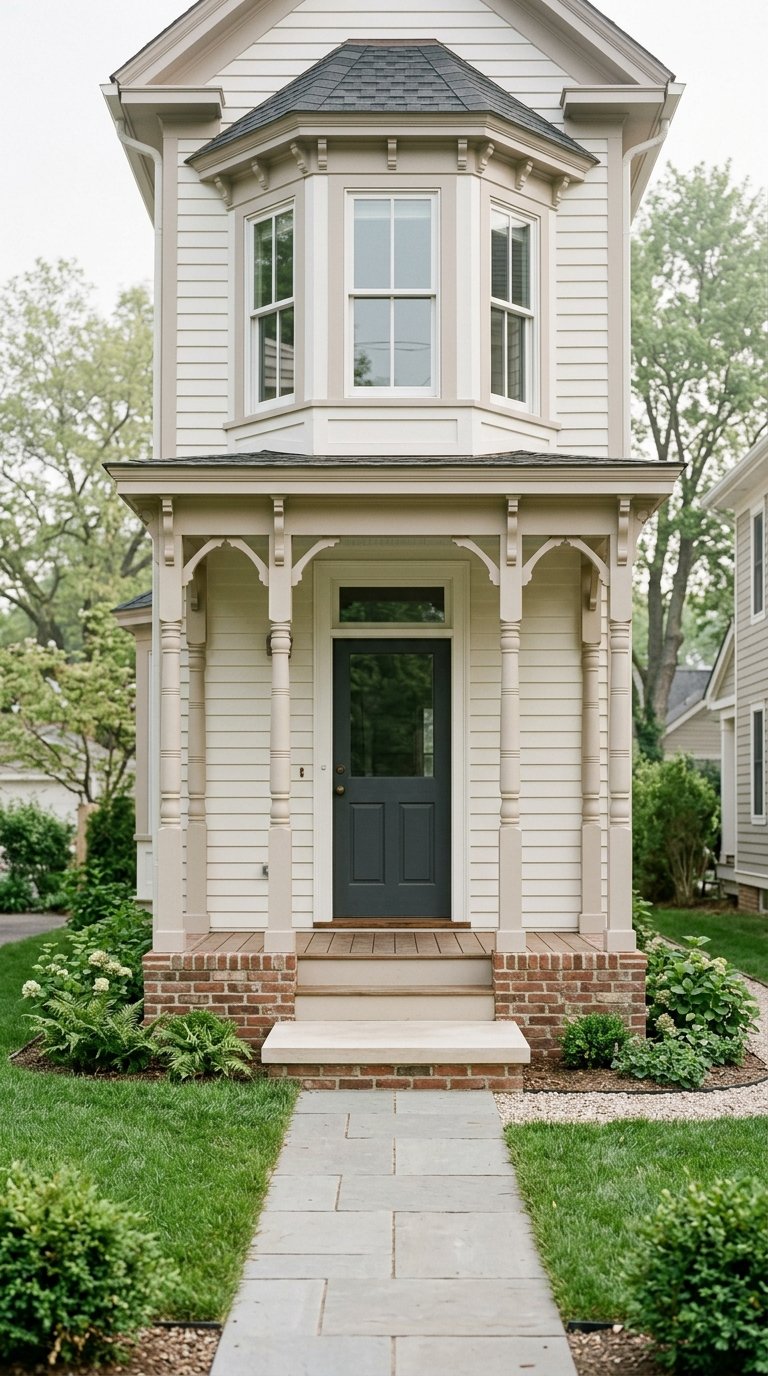
Queen Anne homes are generally asymmetrical, with steep and irregular rooflines, cross gables, dormers or turrets, bay windows, patterned wall surfaces, porches, and decorative spindlework. Folk Victorian houses are usually simpler in form but dressed up with Victorian-era trim such as turned posts, brackets, and spindlework.
With Victorian homes, the decorative features carry a lot of the identity. Roof complexity, porch details, wood trim, and the home’s symmetry or asymmetry often matter just as much as square footage.
That is especially helpful in Kirkwood, where some homes have been altered over time. A house can still be functional and attractive, but if major trim, porch features, or roof details have been simplified, it may feel less true to its original style.
When touring a Queen Anne or Folk Victorian home, focus on:
Kirkwood is not only about bungalows and Victorians. The district also includes several cottage forms, including Georgian Cottage, Gabled Wing Cottage, Queen Anne Cottage, New South Cottage, Pyramid Cottage, and English Cottage.
Georgia preservation guidance draws a useful distinction between house type and style. House type refers to the plan and height, while style refers to exterior ornament. So a cottage’s identity may come as much from its footprint and roof shape as from decorative trim.
For example, a Georgian Cottage is typically a one-story, square or nearly square home with a central hall and rooms on either side. English Cottage forms in Georgia are often more asymmetrical, with steep roofs and gables.
For buyers, cottages can offer a manageable footprint with a lot of charm. Because the original form is often compact, additions need to be sized carefully so the house does not lose its proportions.
Porches, eaves, and rooflines are usually the fastest way to tell whether a Kirkwood home still reads clearly as Craftsman, Victorian, or cottage. Many district homes use wood weatherboard or brick, with brick or concrete foundations and asphalt or metal roofs.
As you look at updates, try to judge them against the home’s original massing and visible details. A replacement may be newer, but that does not always mean it fits the house well.
Window patterns tell you a lot. Queen Anne homes often feature multi-pane, stained, or decorative windows, while Craftsman homes typically lean toward simpler wood trim and bungalow-scale openings.
With cottages, the underlying form may matter more than ornament. In those cases, look at whether current finishes still support the original shape and scale of the home.
Interior circulation affects daily life more than many buyers expect. Craftsman homes often feel more open, Queen Anne homes may move around a central stair, and Georgian cottages often follow a central-hall arrangement.
That layout impacts not only comfort, but also how disruptive a future remodel might be. A house can be beautiful and still function very differently from what you want.
In a neighborhood with strong historic character, additions deserve extra attention. A well-designed rear addition can add valuable space, but one that feels too tall or too boxy can weaken the home’s historic appearance and the block’s overall rhythm.
This is one of the biggest areas where buyers benefit from slowing down and really comparing old and new. Compatibility often matters more than just extra square footage.
Character is only part of the story. If you are buying an older home in Kirkwood, systems and materials deserve real attention too.
Homes built before 1978 are more likely to contain lead-based paint, especially when paint is disturbed during repairs or remodeling. Older building materials can also include asbestos in items such as floor and ceiling tiles, pipe wrap, and insulation.
The Consumer Product Safety Commission recommends electrical inspections for homes 40 years and older, especially if they have been heavily renovated. In practical terms, this means your due diligence should go beyond finishes and floor plans.
Kirkwood’s historic district is listed on the National Register, but that alone does not place federal restrictions on a private owner. For buyers, the more important question is how local rules apply to a specific property.
Atlanta treats historic and landmark districts separately from ordinary zoning. The city’s permitting guidance says exterior work in a designated historic or landmark district can require a Certificate of Appropriateness before a permit is issued.
This is where many buyers can get tripped up. You should verify the property’s actual zoning, overlays, or special district rules before assuming changes to windows, porches, siding, or additions will be simple.
In a neighborhood with as much character as Kirkwood, that step can shape both your renovation budget and your long-term plans.
If you are considering a major rehabilitation, there may be meaningful upside. Georgia’s state income tax credit program for rehabilitated historic property offers a credit equal to 25% of qualifying rehabilitation expenses, capped at $100,000 for a principal residence, if the property meets eligibility and rehabilitation standards.
Georgia guidance also notes that eligibility can extend to properties listed in or eligible for the National or Georgia Register and, for owner-occupied historic homes, to properties contributing to a local district or locally designated as historic. For the right project, that can become an important part of the financial picture.
In Kirkwood, the features that preserve character are often the same features buyers respond to later. Intact porches, authentic rooflines, original trim, coherent window changes, and additions that respect the house’s scale tend to support a stronger first impression.
Because the district’s overall integrity remains good, homes that retain their historic form often stand out. If you are choosing between two properties, the one with more consistent architectural details may feel better now and remain easier to position well later.
The best Kirkwood home for you is not always the largest or the most updated. Often, it is the one whose style still reads clearly, whose changes feel compatible, and whose layout fits the way you actually live.
If you want help comparing Kirkwood Craftsman, Victorian, and cottage homes block by block, working with a local advisor can make the process much more focused. For thoughtful guidance on buying character homes in intown Atlanta, connect with Shawn Morgan.
A thorough grasp of residential real estate marketing tactics, a keen knowledge of the Atlanta market, superior listening skills and attention to detail, make him the model Realtor® advisor. Contact Shawn today!
Let's ConnectAddress
1491 Peachtree St. NE
Atlanta, Georgia 30309